WRECK DIVING IN THE BVI: THE RHONE, CHIKUZEN, ROCUS AND MORE

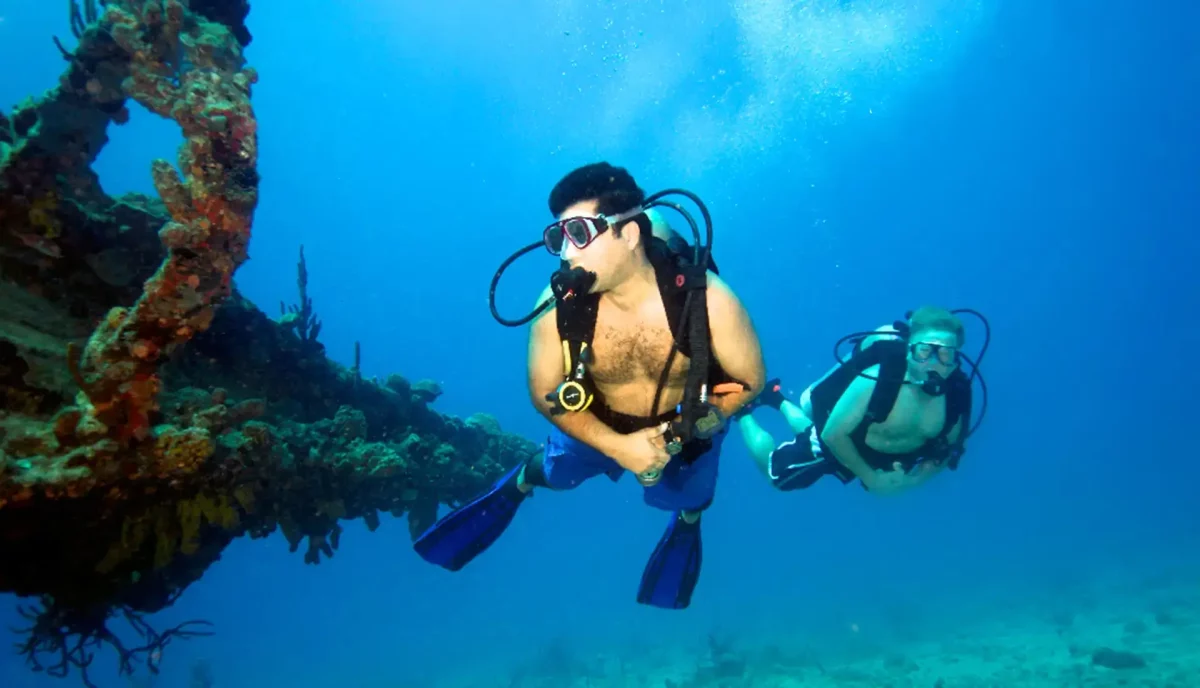
Two scuba divers exploring the deep section of the RMS Rhone wreck in the British Virgin Islands
The deep section of the Rhone sits at around 75 feet — coral-encrusted, atmospheric, and unlike any other wreck dive in the Caribbean.

Wreck diving in the BVI offers some of the finest underwater experiences in the Caribbean — a 19th-century Royal Mail steamer, a Korean fishing vessel that survived fire and a 70-mile drift, and a Pearl Harbor survivor turned art installation. A 19th-century Royal Mail steamer broken in two by a hurricane. A Korean fishing vessel that survived fire, abandonment, and a 70-mile drift before finally sinking in 80 feet of water. A First World War-era cargo ship rusting into a reef on the edge of Horseshoe Reef. A Pearl Harbor survivor repurposed as an underwater art installation.

Each wreck on this list has a story worth knowing before you descend. We have dived all of them — some dozens of times — and what follows is what we know firsthand.

Back to the BVI Scuba Diving Guide

See all BVI dive sites

The RMS Rhone — Salt Island

Depth: 20–80 ft | Level: Intermediate/Advanced | National Park mooring balls on site

The Ship

The RMS Rhone was built at the Millwall Iron Works in London and launched in June 1863. She was 310 feet long with a 40-foot beam — an iron-hulled steam sailor built for the Royal Mail Steam Packet Company, running the route between Southampton and Rio de Janeiro before being reassigned to the Caribbean.

She was a technologically advanced ship for her era. Her bronze propeller was only the second ever produced — the oldest surviving one in existence, as the first was melted down long ago. She carried a surface condenser rather than the saltwater-cooled engines common on other vessels, which meant fresher boiler water and greater efficiency. Brazil’s Emperor Pedro II visited the ship during her inaugural season and was reportedly impressed.

The Rhone accommodated 253 first-class, 30 second-class, and 30 third-class passengers. Captain F. Woolley, a 25-year veteran of the Royal Mail Company, commanded her. She completed six successful voyages to Brazil before being reassigned to the Caribbean route, where she quickly became a favourite among passengers for her speed and comfort.

The Wreck

October 29, 1867. The Rhone was anchored at Peter Island, mid-refit, when the first of two back-to-back hurricanes arrived. The captain got the ship underway, attempting to make open water by the quickest route — around Black Rock between Salt Island and Dead Chest. As she struggled through the passage, a spar fell from the topmast and killed the first officer. His body was found on Salt Island the next day.

She almost made it. As the Rhone cleared the point and entered open water, the eye of the hurricane passed directly overhead. The calm was brief and deceptive. The second half of the storm hit with full force from the opposite direction. Cold seawater hit the overheated boilers and the ship exploded, breaking in two. She sank in minutes.

Of the 143 people on board, only 23 survived. The wreck site became a national marine park in 1980. It has been a protected dive site ever since.

The Dive

 
Two dives are standard and both are required to cover the full site.

The first dive takes you to the bow section at 75 feet. This is the deeper, more dramatic half of the wreck — the hull is largely intact, and you can still make out the machinery, the anchor gear, the structural lines of the iron hull, and the enormous engine room. The second dive covers the shallower stern section. The bronze propeller sits at around 20 feet and is accessible to strong snorkellers. Between the two sections lies a debris field that rewards slow, methodical exploration.

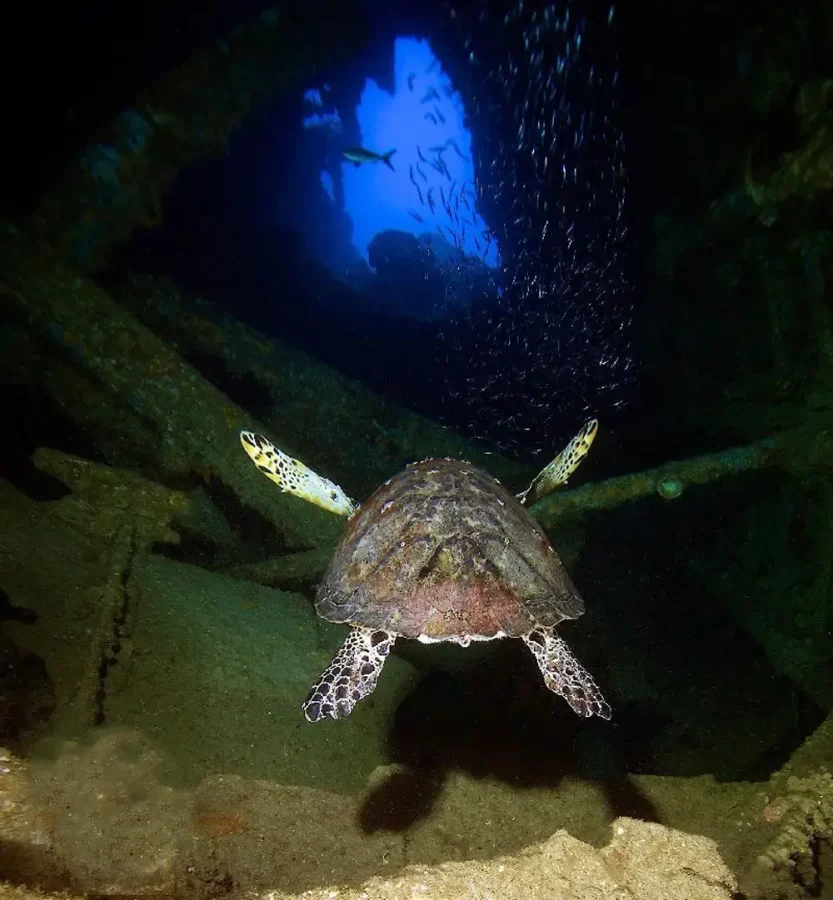
The wreck is so thoroughly encrusted with coral and so densely populated with fish that it functions as much as a reef as a wreck. A large resident barracuda named Fang has been a fixture at the site for years. Hawksbill turtles rest on the hull. Moray eels occupy every crevice. Lobster, octopus, and spotted drums are common throughout.

Two things worth looking for on the bow section: a brass porthole with its glass still intact, polished by divers for decades, and a silver teaspoon embedded in the gearbox — a detail most guides skip past.

The area from the west side of Salt Island to the east side of Dead Chest Island makes up Rhone National Park. Do not anchor or fish within the park boundary. Mooring balls are managed by the National Parks Trust — some are placed for small dive boats rather than charter yachts. If your boat is over 60 feet or all mooring balls are taken, anchor off the beach at the settlement and dinghy around. The dinghy mooring is two blue balls with a line between them — tie to the line and drop in. The Rhone is just west of the large black rock that juts from the shoreline. For snorkelling the shallow stern section, this approach actually puts you in a better position than the mooring balls anyway.

Sea turtle resting on the RMS Rhone wreck in the British Virgin Islands with diver above
The Rhone is as much a reef as it is a wreck — sea turtles, fish, and coral have made it their own over 150 years.

Getting There

Salt Island is accessible from Tortola (Road Town) in under an hour by charter yacht, or by day trip from many close BVI anchorages. The site is sheltered enough to be diveable in most conditions — wind and swell from the north or east is typically not a problem at this location.

The movie The Deep (1977) was filmed here. Peter Benchley, who wrote Jaws, also wrote the novel. Jacqueline Bisset’s scenes were shot on the bow section. The wreck was well-known to divers before the film; the film made it famous everywhere else.

See the full BVI dive sites guide →

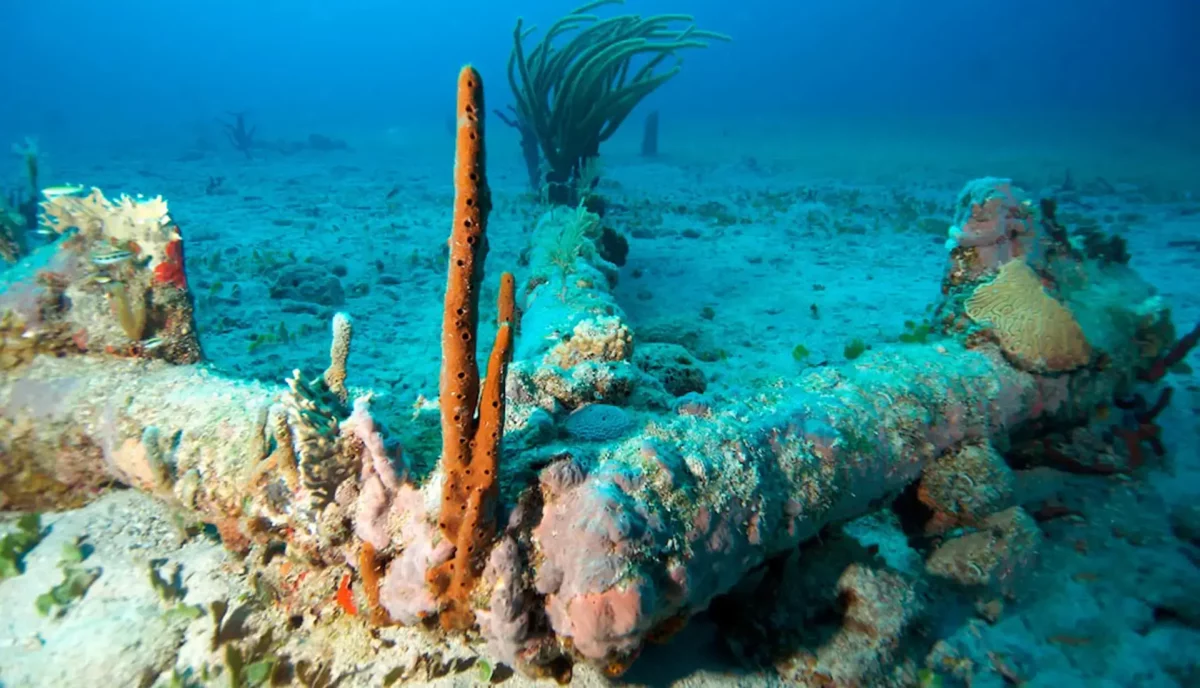
Coral and orange tube sponges growing on the anchor site of the RMS Rhone wreck in the British Virgin Islands
Decades of coral and sponge growth have transformed the Rhone's anchor site into one of the most colourful sections of the dive.

The Chikuzen Wreck — Anegada

Depth: 45–80 ft | Level: Intermediate/Advanced | National Parks mooring ball on site | Calm conditions only

The Ship

The official name is M.S. Chikuzen Maru. She was built in Japan in 1960 and spent most of her working life as a fishing and refrigeration vessel. By the late 1970s she had ended up tied to a dock in St Maarten, operating as a cold storage facility.

In September 1981, a tropical storm threatened the harbour at St Maarten. The harbour master ordered all vessels to move. The owner of the Chikuzen took her to sea, opened the sea cocks, and attempted to sink her. She did not sink. He set her on fire. She still did not sink. Abandoned at sea and trailing smoke, she drifted for three days across 70 miles of open water before appearing off the coast of the BVI, threatening to run aground on Marina Cay.

A tug got a line on her. The tow rope snapped under load, shattering a crewmember’s legs. She was abandoned again, drifting south, and finally sank in the middle of a vast expanse of sand flats 7.5 miles northwest of Tortola. She came to rest on her port side, her starboard rail rising to within 45 feet of the surface.

George and Luana Marler wrote the full story in their book Burning Freighter: The Story of the M.S. Chikuzen Maru, published in 2006. If you can find a copy — it occasionally surfaces in paperback — it is worth reading before you dive the site.

The Dive

Often described as the second-best dive in the BVI after the Rhone. In terms of sheer fish life, it is the best dive in the BVI. Nothing else comes close.

The Chikuzen sits in 75–80 feet of water in the middle of a desert of sand flats. That geographic isolation is the reason the fish life is extraordinary. As soon as she sank, the wreck began attracting fish — she has been building her population for over 40 years now, and the numbers are staggering.

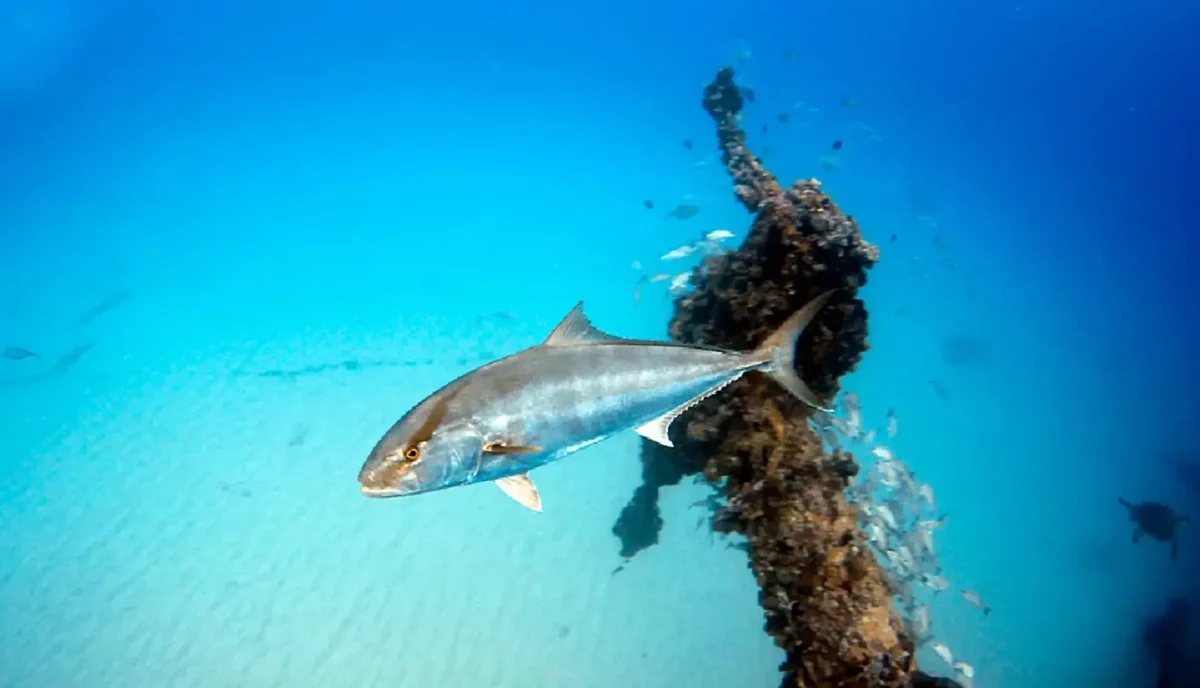
The moment you descend the mooring line, you are in fish. Hundreds of barracuda hang in the water column above the wreck — thick enough that you swim through them on the way down. Goliath grouper in the hundreds-of-pounds range live on the hull, utterly indifferent to divers. Horse jack, almaco jack, lookdowns, pompano, king mackerel, Atlantic spadefish, and cobia patrol the stern. Large southern stingrays cruise the sand flats around the hull. The whale migration path passes directly over the site — if you are lucky with timing and conditions, you may hear them.

She lies on her port side. Her railings, winches, deck fittings, and two massive masts extend almost parallel to the seafloor. Before Hurricane Irma in 2017, the refrigerated holds were one of the highlights — divers could penetrate the interior and see the massive cold storage machinery. Irma collapsed the holds. The exterior structure that remains is still dramatic, and the fish life is completely unchanged.

There are plaques on various pieces of equipment marked in Japanese. The chain from the mooring ball runs along the seafloor to the wreck — follow it in.

Before GPS, finding the Chikuzen required a specific technique: keeping a narrow gap between the eastern tip of Scrub Island and the western end of Ginger Island until you were directly over the site. When the gap was the width of your index finger held at arm’s length, you were there.

GPS: N18°37.143 W064°30.969

Conditions and Access

 
This site can only be dived when the seas are completely flat. There is no shelter from ocean swell, and even a moderate sea state makes the mooring pickup difficult and the dive uncomfortable. The mooring ball is managed by the National Parks Trust — the tagline is often in poor condition, so approach carefully.

When conditions are right and the surface is glassy, the Chikuzen is also an extraordinary snorkel. The barracuda in the water column are visible from the surface, and the shallower sections of the wreck come up close enough to see clearly. Put out a trailing line from the yacht’s stern so snorkellers have something to hang onto in any surface current.

The site is 7.5 miles offshore in open water. It is only realistically accessible by a charter yacht with the range and time to get there, wait for the right conditions, and dive it properly. Day boats from Road Town can reach it in good conditions, but they are entirely dependent on the weather cooperating on their fixed schedule. A charter yacht can wait for the window.

Large amberjack swimming at the Chikuzen wreck dive site near Anegada in the British Virgin Islands
The Chikuzen's remote location means fish life on a scale rarely seen elsewhere in the BVI — schooling amberjack, barracuda, and grouper in numbers that stop divers in their tracks.

The Rocus Wreck — Horseshoe Reef, Anegada

Depth: 5–40 ft | Level: Intermediate | Calm conditions only | Approach from Virgin Gorda side. Local Knowledge Required!

The Ship


The Rocus was a cargo steamer that ran aground on Horseshoe Reef — the vast, largely submerged reef system that extends south and west of Anegada — in 1929. As the crew attempted to kedge the vessel off the reef, a second storm arrived and made refloating impossible. She was abandoned where she lay.

Until 1979, the bow of the Rocus still projected above the waterline. At some point in the 1970s, divers removed the propeller. The wreck has been slowly breaking apart and settling into the reef since — today it lies on its starboard side, with the boilers in only a few feet of water and the stern in about 40 feet.

The Rocus sits at the southern end of Horseshoe Reef, geographically closer to Virgin Gorda than to Anegada’s Settlement. Coming at it from the Virgin Gorda side saves several hours of navigation compared to approaching from Anegada. Keep this in mind when planning the day.

The Dive

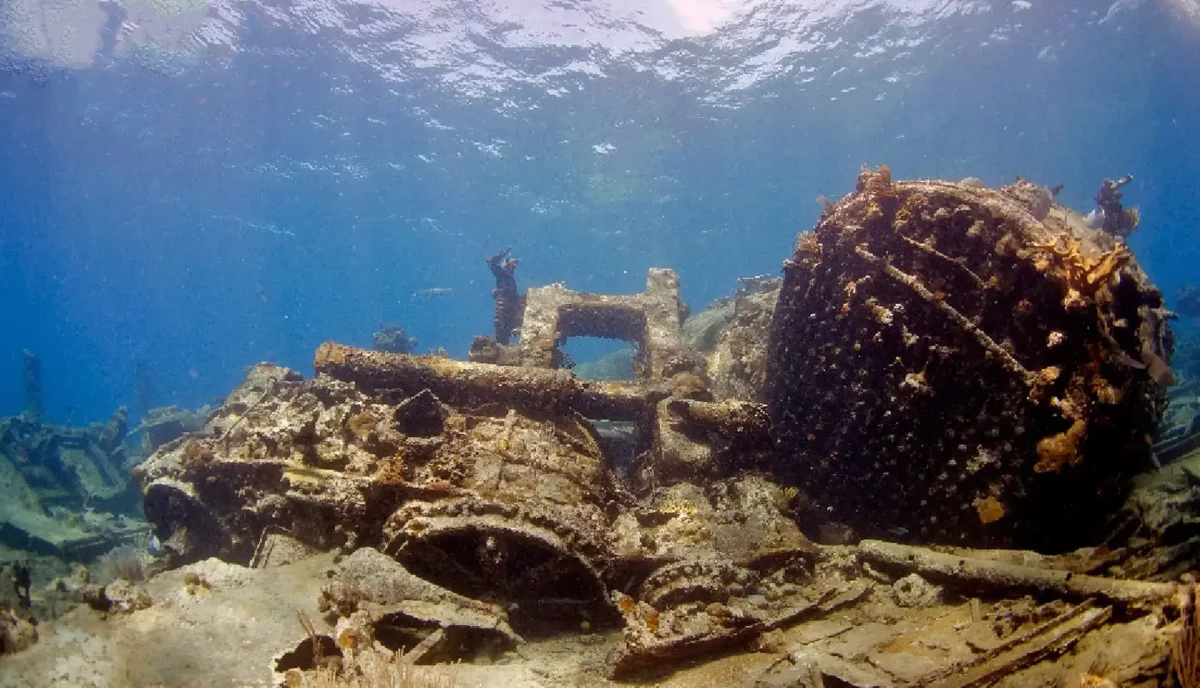
The Rocus does not have the fish life of the Chikuzen. What it does have is character — the boilers, which break the surface in very low water, are encrusted with decades of coral growth and make for dramatic photographs. The surrounding reef holds large barracuda, ocean triggerfish, nurse sharks, and durgeon. The Elkhorn coral in the area is worth noting — it is present in significant quantities and in various states of health, which is increasingly unusual throughout the Caribbean.

The wreck lies in an area of Horseshoe Reef with strong current patterns. The same currents that make the diving variable have created one of the stranger features of the site: cow bones. The Rocus was carrying a cargo that included cattle when she went aground — the bones have been dispersing across the reef and along the western shores of Anegada for nearly a century. Cow Wreck Beach, on the northwest coast of Anegada, is named for them. The Cow Wreck Beach Bar is worth a visit after the dive.

This site can only be dived in flat calm conditions. The shallow boilers can be snorkelled when the swell is low.

Coral-encrusted boiler from the Rocus wreck dive site near Anegada in the British Virgin Islands
The Rocus wreck off Anegada — its coral-covered boiler is one of the most photogenic structures in BVI wreck diving.

The Kodiak Queen — Virgin Gorda

Depth: 55–65 ft | Level: Intermediate | Accessible by charter yacht

The Kodiak Queen was launched in 1940 as a US Navy fuel barge. She was one of only five vessels to survive the Japanese attack on Pearl Harbor on December 7, 1941 — the others were either sunk or heavily damaged. After the war she was repurposed as a fishing vessel and eventually ended up rusting in a Road Town junkyard.

In 2012, historian Mike Cochran began a campaign to document and preserve the ship. Owen Buggy, a photographer with connections to Sir Richard Branson, came across the project and proposed sinking her as an artificial reef off Virgin Gorda’s Long Bay. The BVI government agreed. In March 2017 the Kodiak Queen was cleaned, prepared, and sunk. A giant steel kraken sculpture was added to the hull as an underwater art installation before sinking.

She now sits at 55–65 feet and is already well colonized with coral and fish. The combination of genuine history — Pearl Harbor, the Pacific War, decades of Caribbean fishing — the scale of the vessel, and the kraken installation makes this one of the more unusual and rewarding dives in the BVI. Worth pairing with a dive at nearby The Airplane on Great Dog for a full day in the Virgin Gorda area.

The Airplane — Great Dog Island

Depth: 35–45 ft | Level: Novice/Intermediate | Accessible by charter yacht

In 1993 an Atlantic Air BVI Shorts 360 aircraft aborted takeoff from Virgin Gorda airport and ended up in the water approximately 200 feet off the end of the runway. Rather than salvage it, the BVI’s National Parks Trust sank it deliberately as an artificial reef addition. The aircraft — minus its wings and tail — now sits in a sand patch at about 40 feet on the south side of Great Dog Island.

It is a compact dive by wreck standards. The fuselage can be circled and the interior explored in a single tank. The coral gardens surrounding the aircraft are worth swimming through and the site pairs naturally with Angelfish Reef for a two-dive day in the Dogs area. A straightforward, unusual dive that makes a good second dive after a deeper morning site.

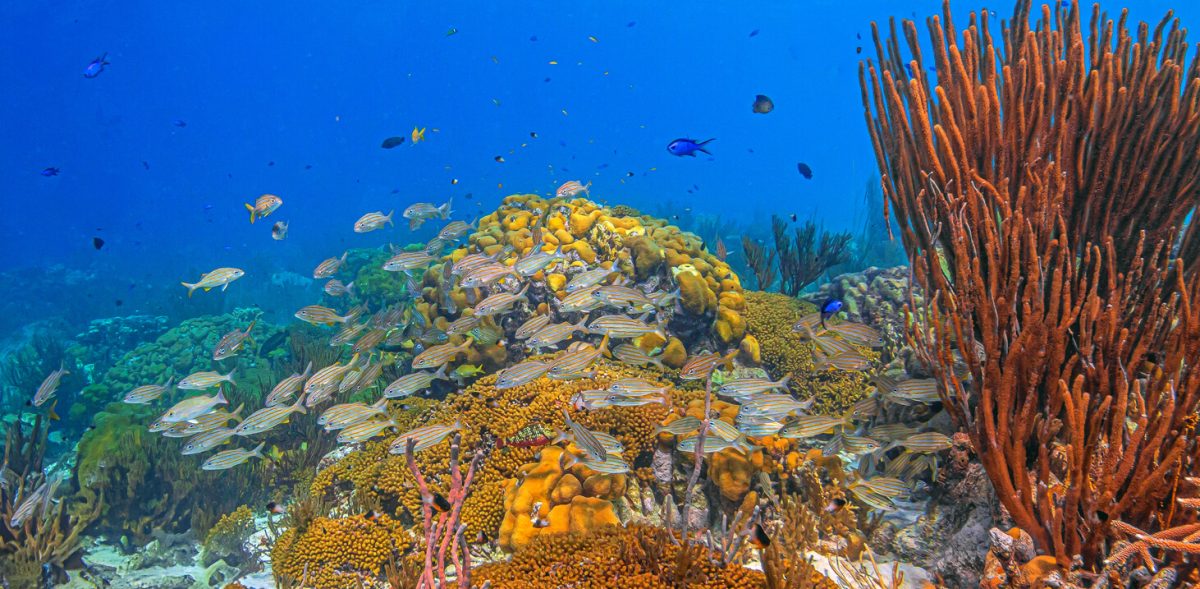
Coral reef and tropical fish at Coral Gardens dive site near Great Dog Island in the British Virgin Islands
Coral Gardens surrounds the airplane wreck on the south side of Great Dog Island — worth swimming through before or after the main attraction.

Planning a Wreck Diving Week in the BVI

A practical wreck-focused charter itinerary works roughly as follows:

Day 1–2: Base near Salt Island — two dives on the Rhone (bow section one day, stern the next), with Painted Walls on Dead Chest as a complementary reef dive.

Day 3: Move to Virgin Gorda — dive the Kodiak Queen, pair it with Angelfish Reef or the Great Dog airplane.

Day 4–5: Passage to Anegada — watch the forecast carefully. When conditions are right, dive the Chikuzen in the morning. Add the Rocus the following day if the weather holds. Overnight at Setting Point.

Day 6–7: Return south — Norman Island wreck alley, the Indians, finish near Tortola.

The Chikuzen is the pivot point of any serious wreck week. It requires flat conditions and those conditions may or may not arrive on schedule. Build flexibility into your itinerary and trust your captain’s read on the weather. When the window opens, the Chikuzen is worth every hour you waited for it.

Diving the Wrecks from a Charter Yacht

Shore-based dive operations can reach most of these sites on day trips in suitable conditions. What a charter yacht provides is the flexibility to wait — to let the forecast develop, to position overnight close to the Chikuzen mooring, and to dive the site in the flat morning calm before any swell builds. For the offshore wrecks especially, that flexibility makes the difference between diving the site and missing it.

We have operated dive charters in the BVI for nearly 20 years. Our team holds PADI and NAUI certifications at Instructor and Divemaster level. We know which vessels have the right compressor capacity, the right tender for offshore conditions, and the right crew experience for wreck diving. Tell us what you are looking for and we will match you to the right yacht.

← Back to the BVI Scuba Diving Guide

← See all BVI dive sites

Travel Agents
Scroll to Top

Looking for more options?

Our main collection features a hand-picked selection of truly exceptional yachts — chosen for their quality, crew, and overall charter experience. If you’d like to explore a broader range of yachts across additional destinations, you can view our full worldwide charter portfolio.